How to Create a Transportation App: Features,
Price, and Implementation Steps
29 Aug 2023
18 min

CTO

Technical Writer
How to Create a Transportation App: Features, Price, and Implementation Steps
Logistics and supply chain management are constantly evolving and digitizing to meet customers’ growing needs. Transportation applications significantly benefit logistics and transportation companies, and all other businesses rely on transportation. According to a study by Mordor Intelligence, the demand for transportation services is expected to grow at a CAGR of 4.07% during 2023 -2029. Thus, transportation software solutions provide an excellent opportunity for you to increase your transportation business share and outperform your competitors.
As an experienced IT provider with 11+ years of experience in Logistics, we at Cleveroad are ready to share our expertise in transportation app development and tell you all about the transportation app development, including functionality, cost of such a solution, and preparatory steps to ensure successful product launch.
What Is Transportation App, and Why Do Businesses Need It?
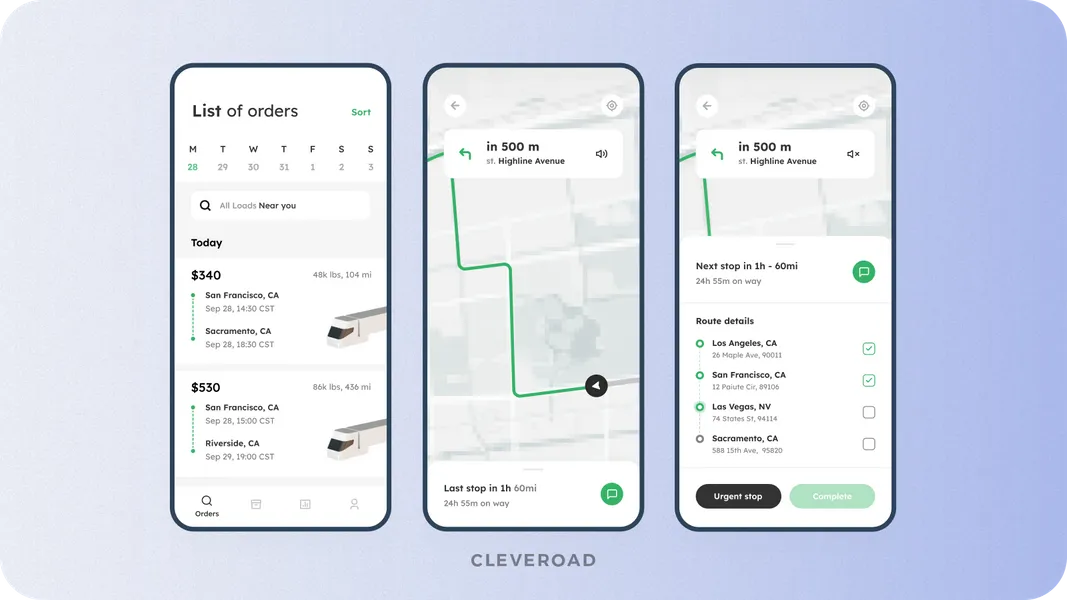
Transportation app is a specialized software designed to manage, optimize, and improve transportation and logistics processes. Building a transportation app provides transportation and logistics companies, as well as other businesses that depend on transportation services, for example, taxi services, rideshare platforms, or logistics providers, with the means to organize and coordinate the transportation of goods or people.
Here are the benefits of transportation app development for logistics and transportation organizations and all other businesses that rely on transportation services:
- Route and time optimization. The transportation app allows you to automate the calculation of optimal routes for the delivery of goods or passengers, considering traffic, distance, and other factors. By optimizing routes, you can reduce travel time and fuel and resource costs. The study by THERMAL SCIENCE shows that route optimization lowers fuel costs by
- Improved operational efficiency. Transportation apps provide real-time vehicle position and status tracking via GPS integration. Thus, transport app development allows you to quickly react to plan changes, prevent delays, and provide more accurate delivery time forecasting. According to Verizon Connect’s survey,
- Better warehouse operations management. The transportation app can integrate with warehouse management systems to facilitate inventory tracking, management, and delivery planning. According to the SupplyChain 24/7 survey, about 36% of the respondents admit to a more balanced supply and demand model via predictive warehouse analytics and transportation app integration.
- Improved customer experience. By providing customers with real-time data on the status and location of shipments or vehicles, the transporting app helps improve customer service and satisfaction. Moreover, according to a study conducted by Dot Distribution, delivery time affects 87% of the purchasing decisions made by online shoppers. Thus, transportation app development allows faster deliveries, increasing customer satisfaction and quantity.
- Reduced costs. Optimizing routes and resources, more accurate scheduling, and more efficient transportation can reduce operating costs and improve business profitability. The ARC Advisory Group research shows that savings from optimization with transportation app development and integration can reach more than 10%
- Improved data analysis. The transportation app collects data on order fulfillment, routes, delivery times, and other critical aspects. Managers can analyze this information to identify trends, risks, and possible improvements in company performance. Forbes states that 85% of companies say that analyzing performance data allows them to succeed and grow faster.
- Eco-efficiency. According to a study from Sustainable America, on average, the U.S. wastes about 3.8 million gallons of gasoline daily while idling in traffic. This is equivalent to 40000 tons of CO2. Optimizing routes and resources by creating a transportation app helps reduce CO2 emissions and other negative environmental impacts.
Preparations Steps Before Transportation App Development
Building a transportation app requires going through several important preparatory steps to help you identify your solution’s essentials. Let’s take a look at the main points you should pay attention to:Define the purpose of your app
Before you start transport app development, determine what the purpose of your app is. Choose whether you want to create a SaaS-based solution to offer transportation services for a recurring fee. Or you want to develop an app tailored specifically to your transportation and logistics business. Clarifying the app’s goal will help you focus on the required features and functions.Analyze the market
Conduct a detailed market analysis to identify your app’s target audience and study your competitors. Determine what needs and problems exist in the market and how your transportation platform can solve them. This step will help you better understand what features and modules should be included in your logistics solution. Also, by studying your competitors’ experience, you can get valuable insights into their success and avoid their mistakes during app development for transport.Choose a monetization model
Think about how you can make money by creating a transportation app. The monetization model for transport apps may include:- Subscriptions. You can increase customer satisfaction with your transportation app by providing premium features when you purchase a subscription.
- Paid features. You can offer users additional paid features, such as a better class of cars or different interaction options, allowing users to optimize their trips.
- Advertising. You can also increase revenue by partnering with advertisers to display targeted ads while maintaining a seamless user journey.
- Transaction fees. Ensure a seamless transaction experience in your transportation app by charging users for completed trips or deliveries.
Select integrations (if necessary)
Consider what integrations might be helpful for your transportation app. The choice of integrations for transportation app development will depend on the type and goals of your platform. The integrations for your transporting app may include:- Payment gateways
- GPS and mapping services
- Messaging and chat
- Weather services
- Ride-sharing APIs
- IoT devices
- Inventory manag systems
- APIs for multi-modal transport
- Analytics tools, etc.
Choose an experienced technical partner
A reliable IT partner who will create a quality solution that meets all your business needs is key to successful transportation app development. Research the market and compare different options. Ensure the vendor you choose has solid experience in Logistics app development, study the portfolio to assess the company’s expertise, and check customer reviews on platforms like Clutch . A professional software provider will help you with intelligent transportation systems development, advise you on potential issues, and help you through all the preparatory steps. By cooperating with a reliable tech partner right from the initial stages, you can better plan the project and develop a transportation app with the necessary functionality for for your target audience.FAQ
A transportation app is specialized software designed to manage, optimize, and enhance transportation and logistics processes. It offers functionalities like route optimization, real-time tracking, automated processes, and integration with various systems.
Creating a transport app involves several key steps. First, define the purpose of your app – whether it’s a standalone SaaS-based solution or integrated into your logistics systems. Conduct market analysis to identify your target audience and competitors. Choose a monetization model. Then select necessary integrations like GPS, payment systems, and more. Finally, look for an experienced development team to design, develop, test, and deploy your app.
Transportation apps offer a range of benefits, such as cost and time savings, enhanced operational efficiency through real-time tracking, routine tasks automatization,improved customer experiences, better data analysis, etc.
The cost of developing a transportation app varies based on factors like the type of app, features, complexity, design, platforms, and more. Commonly, the cost for such a solution can range from $50,000 to $250,000 or more.

Evgeniy Altynpara is a CTO and member of the Forbes Councils’ community of tech professionals. He is an expert in software development and technological entrepreneurship and has 10+years of experience in digital transformation consulting in Healthcare, FinTech, Supply Chain and Logistics